
If you’ve ever thought about diving into the world of HVAC (Heating, Ventilation, and Air Conditioning), Become an HVAC PRO_The Ultimate HVAC Guide positions itself as a complete, start-to-finish solution. Whether you’re a total beginner, a career shifter, or someone looking to sharpen existing skills, this course promises to take you from zero to a professional-level understanding of HVAC design.
What immediately stands out is how ambitious the course is. It doesn’t just skim the basics—it aims to cover everything from foundational science concepts all the way to real-world system design and software usage. Add in things like downloadable tools, sample projects, and lifetime access, and it’s clear this course is trying to deliver serious value for aspiring engineers and technicians.
Instructor Reputation
When it comes to instructor credibility, Augmintech Education Pvt Ltd brings a lot to the table—and it shows in how this course is received by students. With over 31,000 learners enrolled, close to 5,000 reviews, and an overall 4.2 rating, they’ve clearly built a strong footprint on Udemy. That kind of scale doesn’t happen by accident—it usually means they’ve been consistently delivering value across multiple courses.

What makes Augmintech particularly interesting is their positioning. They’re not trying to be overly academic or purely theoretical. Instead, their entire brand revolves around making engineers “field-ready.” That’s a big deal, especially in a technical discipline like HVAC where practical knowledge often matters more than textbook memorization. Their mission statement emphasizes real-world application, and you can feel that philosophy reflected in how this course is structured and delivered.
Another strong point is their global teaching experience. According to their profile, they’ve worked with students from over 100 countries. That usually forces instructors to simplify explanations, remove unnecessary jargon, and adapt to different learning speeds—which likely explains why so many students describe the course as “easy to follow” despite its technical depth.
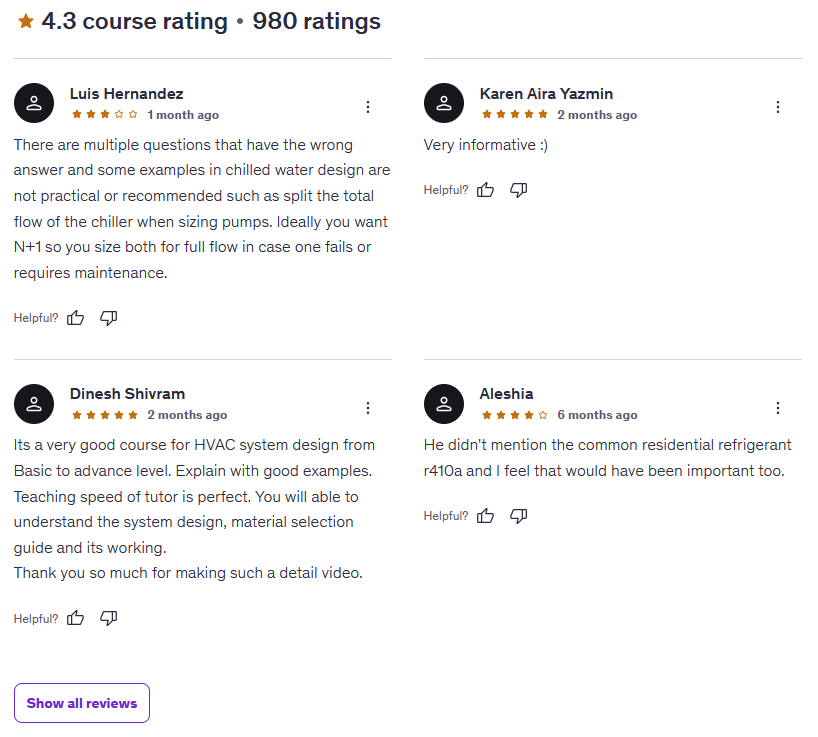
Looking at the reviews, there’s a clear pattern:
- Students consistently praise the clarity of explanations
- Many highlight the depth of content, especially for beginners
- Several mention that the course helped them feel confident applying HVAC concepts in real scenarios
For example, one student even noted they could confidently perform load calculations for residential and commercial buildings after completing the course. That’s a pretty strong endorsement and suggests the teaching isn’t just theoretical—it’s actually usable.
That said, the feedback isn’t 100% flawless—and that’s worth mentioning for balance. A few learners pointed out areas where the course could improve, such as:
- Missing or incomplete reference materials (especially charts and graphs)
- Occasional gaps in covering certain industry-standard details (like specific refrigerants)
- A desire for more comprehensive documentation to support independent problem-solving
These criticisms are relatively minor compared to the overall positive sentiment, but they do highlight an important point: Augmintech excels at teaching concepts, but could improve slightly on completeness and supporting resources.
Overall, though, the instructor reputation here is strong. Augmintech comes across as a practical, career-focused educator rather than just a content creator. If your goal is to actually use HVAC knowledge in the real world, they’re a solid choice—and their track record backs that up.
Course Structure
The structure of Become an HVAC PRO_The Ultimate HVAC Guide is honestly one of its biggest selling points. This isn’t a loosely organized collection of lectures—it’s a carefully designed, step-by-step roadmap that takes you from absolute beginner to a level where you can realistically start thinking like an HVAC designer.

Right from the beginning, the course sets the tone with a proper introduction to the HVAC world. Instead of jumping straight into calculations or formulas, it starts with fundamentals like:
- What HVAC actually is
- Industry standards and organizations
- The role of an HVAC design engineer
- The overall process of system design
This is a smart move because it gives you context early on. You’re not just learning isolated topics—you’re understanding how everything fits together in the real world.
From there, the course transitions into core scientific principles, covering topics like pressure, heat transfer, thermodynamics, refrigerants, and the vapor compression cycle. These sections form the backbone of your understanding, and they’re especially valuable if you’re coming in with little to no background in HVAC.
Once the fundamentals are in place, the course moves into one of the most important (and often intimidating) areas: psychrometry. Instead of glossing over it, the course dives deep into:
- Air properties (humidity, temperature, enthalpy, etc.)
- Psychrometric charts
- Real HVAC processes like cooling, heating, dehumidification, and air mixing
This is where the course really starts to feel professional-level, because these concepts are heavily used in actual HVAC design work.
After that, things get even more practical with an extensive section on cooling load calculations—arguably one of the most critical skills for any HVAC designer. What’s impressive here is the multi-layered approach:
- Manual calculations (to understand the logic)
- Excel-based calculations using the E-20 form
- Software-based calculations using HAP
This progression is incredibly useful. It ensures you’re not just clicking buttons in software—you actually understand what’s happening behind the scenes.
The course doesn’t stop there. It continues into system design components, including:
- Duct design (manual + software-based using McQuay Duct Sizer)
- Air filters and air quality considerations
- Air terminals and their placement/design
- Air Handling Units (AHUs), including types and components
These sections make the course feel very “industry-ready,” especially since they’re tied to practical applications and sample projects.
Another standout feature of the structure is the inclusion of real tools and resources, such as:
- HAP software training
- Psychrometric calculators
- Excel sheets for load calculations
- Sample building plans and layouts
This isn’t just theory—it’s hands-on learning, which is exactly what most learners are looking for.
On top of that, the course includes:
- Quizzes and assignments to reinforce learning
- Downloadable files and handbooks
- Free data books and software links
- Lifetime access and ongoing updates
All of this adds layers to the learning experience and makes the course feel more like a full training program rather than just a video series.
If there’s one small critique, it’s that the sheer depth of content can feel a bit overwhelming at times—especially for complete beginners. There’s a lot to take in, and some sections might require revisiting multiple times to fully grasp.
But overall, the structure of Become an HVAC PRO_The Ultimate HVAC Guide is exceptionally well thought out. It builds knowledge logically, balances theory with practice, and gradually transforms you from a beginner into someone who can confidently approach real HVAC design problems.
Content Quality
When it comes to content quality, Become an HVAC PRO_The Ultimate HVAC Guide does a lot of things right—and a few things that could still be improved—but overall, it delivers a strong, practical learning experience that stands out in its category.
First off, the biggest strength here is clarity. HVAC is not an easy subject—it involves thermodynamics, heat transfer, fluid mechanics, and a bunch of technical calculations that can easily overwhelm beginners. But this course does a solid job of breaking those concepts down into digestible lessons. The instructor uses a mix of simple explanations, structured slides, and visual aids to make complex topics feel manageable rather than intimidating.
A standout feature is the use of animations and step-by-step walkthroughs. Instead of just throwing formulas at you, the course visually demonstrates how processes like the vapor compression cycle or psychrometric changes actually work. This makes a huge difference, especially for visual learners. You’re not just memorizing—you’re actually understanding.
Another major plus is the depth of the content. This course doesn’t cut corners. It goes deep into areas that many other HVAC courses either skip or only briefly touch on, such as:
- Detailed psychrometric analysis
- Manual cooling load calculations (with breakdowns of each component)
- Real-world factors like infiltration, ventilation, and solar heat gain
- Full system design considerations
This depth is exactly why many students say they feel confident applying what they’ve learned in real-life scenarios. It’s not surface-level knowledge—it’s usable, job-relevant skill-building.
On top of that, the course leans heavily into practical application, which is a huge win. You’re not just watching lectures—you’re actively learning through:
- Sample projects
- Building layout analysis
- Software tools like HAP and duct sizing programs
- Excel-based calculation sheets
These elements make the course feel more like a hands-on training program than a passive learning experience. If your goal is to actually work in HVAC design, this kind of practical exposure is incredibly valuable.
The inclusion of downloadable resources is another highlight. Things like Excel sheets, handbooks, and sample plans help reinforce learning and give you tools you can continue using even after finishing the course. It adds a layer of long-term value that many courses lack.
Now, in terms of weaknesses, there are a few areas where the content could be better. Some students pointed out that:
- Certain reference materials (charts/graphs) are not fully provided
- Some explanations rely on partial data, which can make independent practice harder
- A few industry-specific details are either missing or not covered in enough depth
These issues don’t necessarily break the learning experience, but they do affect how smoothly you can transition from guided lessons to самостоятель practice. In a course this technical, having complete reference material is especially important.
Another minor drawback is that the course can feel dense at times. There’s a lot of information packed into it, and beginners might occasionally feel overwhelmed—especially during the more technical sections. However, this is also a side effect of the course being so comprehensive, so it’s more of a trade-off than a flaw.
Overall, the content quality is impressive, practical, and highly informative. It strikes a great balance between theory and application, and while it’s not perfect, it delivers far more value than most courses in this space.
Overall Course Rating – 8.5/10
Taking everything into account, Become an HVAC PRO_The Ultimate HVAC Guide earns a strong 8.5/10 in my book. It’s a course that clearly aims high—and for the most part, it succeeds in delivering a comprehensive and career-focused HVAC learning experience.

What really drives this rating up is the depth and practicality of the course. It doesn’t just teach you concepts—it walks you through how those concepts are applied in real HVAC design scenarios. From manual calculations to software tools like HAP, you’re gaining skills that are directly relevant to the industry. That alone makes it a standout option for anyone serious about pursuing HVAC as a career.
Another big factor is how accessible the course is despite its complexity. Beginners can start from scratch and gradually build up their knowledge, while more experienced learners can use it as a refresher or even fill in gaps in their understanding. That kind of flexibility adds a lot of value and broadens its appeal.
The structured learning path also plays a huge role in the overall rating. The course feels intentional—it guides you step by step rather than leaving you to piece things together on your own. Combined with the included resources, projects, and tools, it creates a learning experience that feels complete and well thought out.
That said, it’s not without its flaws. The main things holding it back from a higher score are:
- Incomplete or limited reference materials in some sections
- Occasional gaps in detail for certain topics
- A slightly overwhelming level of density for absolute beginners
These are relatively minor issues in the grand scheme of things, but they do prevent the course from reaching that “top-tier” 9 or 10 rating.
Still, for anyone looking to get into HVAC design—or seriously level up their skills—this course is absolutely worth considering. It offers a ton of value, teaches real-world skills, and provides a solid foundation that you can build a career on.
Bottom line: if you’re willing to put in the time and effort, Become an HVAC PRO_The Ultimate HVAC Guide can genuinely take you from beginner to a confident HVAC designer.