
So, you’ve got that entrepreneurial itch? You dream of launching a business, being your own boss, and maybe even making millions. But there’s just one tiny problem—you have no idea where to start. Enter Intro to Entrepreneurship: Get Started as an Entrepreneur on Udemy, a course promising to take you from clueless to confident. But does it deliver? Let’s break it down.
Instructor Reputation
Let’s be honest—anyone can slap together a Udemy course these days, call themselves an “entrepreneur,” and start charging for their so-called expertise. But Evan Kimbrell? He’s the real deal.
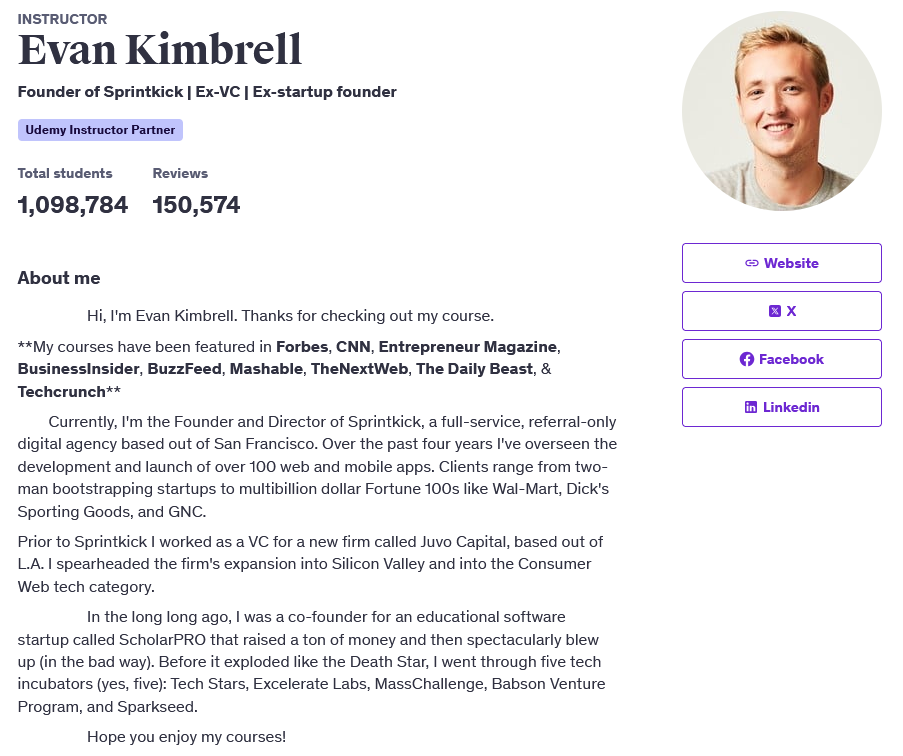
Kimbrell isn’t just a guy who talks about business; he’s done business. His background includes working as a venture capitalist in Silicon Valley, where he was directly involved in high-stakes investments in companies like Facebook, LinkedIn, and Tesla. That alone tells you he’s been in rooms with some of the sharpest minds in the industry. But he didn’t just stay on the investment side of things—he got his hands dirty as a startup founder, raising multiple rounds of capital for his own business.
These experiences give him a unique perspective. He understands both the challenges entrepreneurs face when starting from scratch and what investors actually look for when evaluating business ideas. That’s a rare combination.
And let’s talk about his teaching credentials. Kimbrell is one of Udemy’s top-rated instructors, with a mind-blowing 30,000+ five-star reviews and over a million students. His 24 courses consistently receive rave reviews, averaging around 4.5 to 4.9 stars. That’s not something you achieve by accident—clearly, he knows how to break down complex topics in a way that makes sense.
What sets him apart from other instructors?
- He’s been through it all. Unlike some “coaches” who have never built anything themselves, Kimbrell has started, scaled, and even failed in business. He openly discusses his startup that raised tons of money but ultimately failed—giving real, unfiltered insights that help students avoid the same mistakes.
- He teaches practical, actionable steps. This isn’t just motivational fluff about “believing in yourself.” Kimbrell provides actual frameworks, strategies, and techniques that you can implement immediately.
- He keeps things engaging. Many business courses can feel like dry college lectures, but Kimbrell’s delivery is dynamic, fast-paced, and packed with energy. You won’t feel like you’re slogging through boring theory—his teaching style keeps you hooked.
If you’re going to learn entrepreneurship from someone, you want it to be from someone who’s actually built, funded, and scaled businesses—not just someone who read a few books on the subject. Kimbrell fits the bill perfectly.
Course Structure
When you hear “Intro to Entrepreneurship,” you might assume it’s just a surface-level course that barely scratches the topic. Nope. This course is stacked with content—covering everything from foundational business principles to advanced strategies for validating and launching business ideas.

Intro to Entrepreneurship: Get Started as an Entrepreneur is structured in a way that guides you step by step through the entrepreneurial journey. Here’s how it flows:
1. Understanding Entrepreneurship
The course starts by busting common myths about entrepreneurship and setting realistic expectations. Kimbrell doesn’t sugarcoat things—he makes it clear that running a business isn’t all glamor and easy money. Instead, he lays out the key traits you need to succeed and how to assess whether entrepreneurship is even the right path for you.
2. Finding the Right Business Idea
Not all ideas are good ideas, and this course makes that crystal clear. Kimbrell walks you through different ways to generate business ideas, including:
✔ Problem identification – Finding pain points in industries that need solutions.
✔ Disruptive business models – Learning from innovations like SaaS, the sharing economy, and pay-what-you-want models.
✔ Market enablers – Identifying gaps in existing markets where you can step in.
By the end of this section, you won’t just have vague ideas—you’ll have real, actionable business concepts with the potential to work in the real world.
3. Validating Your Business Idea
This is where many entrepreneurs fail—they jump into a business without testing if anyone will actually pay for it. Kimbrell teaches five different validation techniques, helping you avoid sinking time and money into something that won’t take off. You’ll learn how to:
✅ Conduct quick market research
✅ Get real customer feedback before launching
✅ Test ideas with a minimal viable product (MVP)
✅ Use pitch experiments to gauge investor interest
These strategies can literally save you thousands of dollars and months of wasted effort.
4. Understanding Business Models & Scalability
A great idea isn’t enough—it has to be scalable. This section teaches you how to evaluate whether your business has long-term potential. Kimbrell dives into different business models and shows how some models (like subscription-based businesses) create more opportunities than others.
5. Funding & Finance
At some point, you’ll need money to grow your business. Whether it’s bootstrapping, seeking angel investors, or applying for a small business loan, this section breaks down all your funding options. More importantly, it helps you assess which funding method makes the most sense for your business strategy.
6. Pitching Investors & Business Growth Strategies
Many courses stop after the basics, but this one goes further. Kimbrell teaches how to craft a strong investor pitch, attract venture capital, and strategically scale your business.
Content Quality
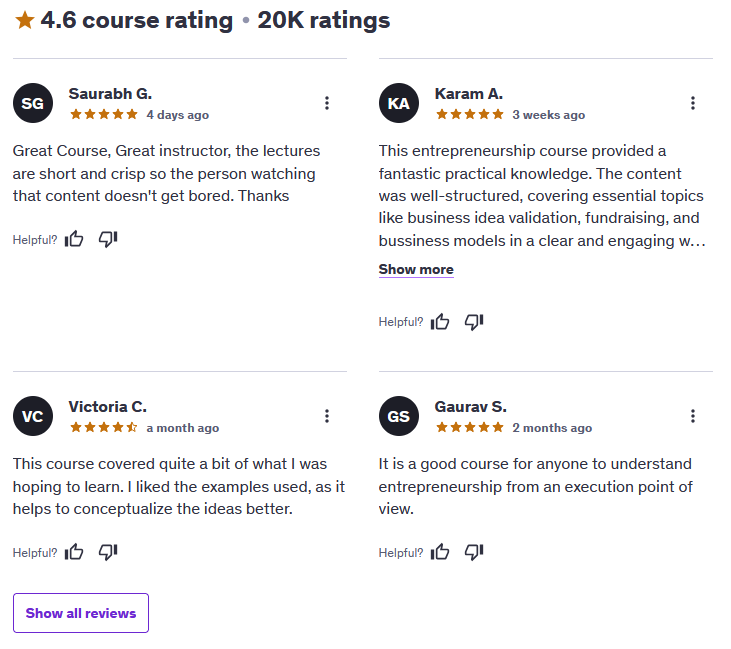
If you’ve ever taken an online course that felt like a glorified TED Talk—light on real value and heavy on vague motivation—you know how frustrating that can be. Fortunately, Intro to Entrepreneurship: Get Started as an Entrepreneur doesn’t fall into that trap. Evan Kimbrell delivers a no-BS, high-value learning experience that balances real-world insights with hands-on practicality.
A Course Built on Actionable Knowledge
One of the strongest aspects of this course is its emphasis on doing rather than just learning. Kimbrell doesn’t just throw a bunch of abstract concepts at you and call it a day. Instead, he breaks down each topic into digestible steps, helping you actually apply what you learn. By the time you finish, you won’t just understand entrepreneurship—you’ll have the tools to start making moves.
For example, when he talks about business idea generation, he doesn’t just say, “Think outside the box.” Instead, he provides:
✔ Proven brainstorming techniques that have been used by real startups.
✔ Frameworks for evaluating business ideas to avoid chasing dead-end opportunities.
✔ Market analysis methods that help you determine if an idea has real demand.
Similarly, when it comes to business models, he doesn’t just explain the concept—he goes deep into the different types of business models that work in today’s world, including:
✔ Subscription-based businesses (think Netflix, SaaS, and membership models).
✔ The sharing economy (like Uber, Airbnb, and other decentralized platforms).
✔ Disintermediation strategies (cutting out the middleman to create value).
This depth makes the course incredibly valuable, especially for beginners who need concrete guidance rather than fluffy, feel-good advice.
Clear, Engaging, and Well-Structured Lessons
Kimbrell’s teaching style is another huge plus. He doesn’t ramble, and he doesn’t waste time on filler content. Each lecture is focused, concise, and easy to follow, making even complex concepts feel approachable.
A lot of online courses struggle with engagement because instructors either talk too fast, drone on endlessly, or lack charisma. Kimbrell avoids all these pitfalls by keeping his energy up and his explanations clear. His real-world experience shines through, making his lessons feel like advice from a mentor rather than a scripted classroom lecture.
Additionally, the course is structured logically, so you’re never left wondering “Wait, why are we talking about this?” It follows a natural progression from understanding entrepreneurship to generating ideas, validating them, and finally launching and scaling a business.
Content Depth: Enough to Be Valuable, But Not Overwhelming
One concern with introductory entrepreneurship courses is that they’re often either too surface-level (not providing enough value) or too technical (leaving beginners confused). This course strikes the perfect balance.
✔ It’s comprehensive enough to give you a strong foundation in entrepreneurship.
✔ It’s detailed enough to give you actionable steps.
✔ But it’s not overly complicated—you won’t feel lost or overwhelmed.
That said, if you’re looking for advanced strategies in areas like financial modeling, deep market research, or growth hacking, this might not be the only course you need. However, as a first step into entrepreneurship, it’s nearly perfect.
Overall Course Rating – 9/10
Let’s cut to the chase: If you’re serious about starting a business but have no idea where to begin, Intro to Entrepreneurship: Get Started as an Entrepreneur is a 9/10—an outstanding resource that gives you the mindset, tools, and practical strategies to launch your entrepreneurial journey.

Why This Course Earns High Marks
1️⃣ Instructor Expertise (10/10) – Kimbrell’s real-world experience as a VC, startup founder, and digital agency director gives him unmatched credibility. You’re learning from someone who’s actually done what he teaches.
2️⃣ Content Quality (9/10) – The course covers everything you need to know, from idea generation to investor pitching, without fluff or filler. The only reason it’s not a perfect 10 is that it doesn’t dive deep into advanced business finance or marketing strategies—but for an introductory course, it’s fantastic.
3️⃣ Engagement & Delivery (9.5/10) – Kimbrell’s teaching style is engaging, clear, and fast-paced, keeping you interested without dragging things out.
4️⃣ Actionable Takeaways (9/10) – Every section provides tangible steps you can take immediately, making this course a real-world guide rather than just a collection of lectures.
What Could Be Improved?
While this course is an excellent starting point, it does leave room for growth in certain areas:
- More real-world case studies would be a nice addition. While the frameworks and strategies are excellent, seeing more real-life examples of entrepreneurs applying these lessons could provide additional inspiration.
- Some more depth in scaling & financial planning would make it an even more complete resource. If you’re planning on raising millions in venture capital, this course won’t give you the advanced financial tools you need—but it does prepare you for the basics.
Who Should Take This Course?
✔ First-time entrepreneurs who want to learn how to come up with and validate business ideas.
✔ Anyone with an interest in business who wants to understand what it takes to build a successful company.
✔ Aspiring startup founders who need a structured approach to getting started.
🚫 Who Might Need More?
- If you’re already deep into entrepreneurship and looking for advanced funding, scaling, or marketing strategies, you might need to supplement this course with additional resources.
- If you’re expecting step-by-step guidance on launching a specific type of business (e.g., an e-commerce store or SaaS startup), this course provides general frameworks but doesn’t specialize in any single industry.
Final Verdict: Should You Take This Course?
If you’re even remotely considering entrepreneurship, this is hands-down one of the best courses you can start with. It’s engaging, insightful, and most importantly—practical.
🌟 Final Score: 9/10 🌟
Whether you’re just toying with the idea of starting a business or you’re seriously ready to take action, this course will give you the foundation you need. You’ll walk away with a better understanding of entrepreneurship, a clear framework for generating and validating ideas, and the confidence to take the next step toward building your own business.
🔥 Highly recommended for anyone looking to take control of their career and create something of their own. 🚀